


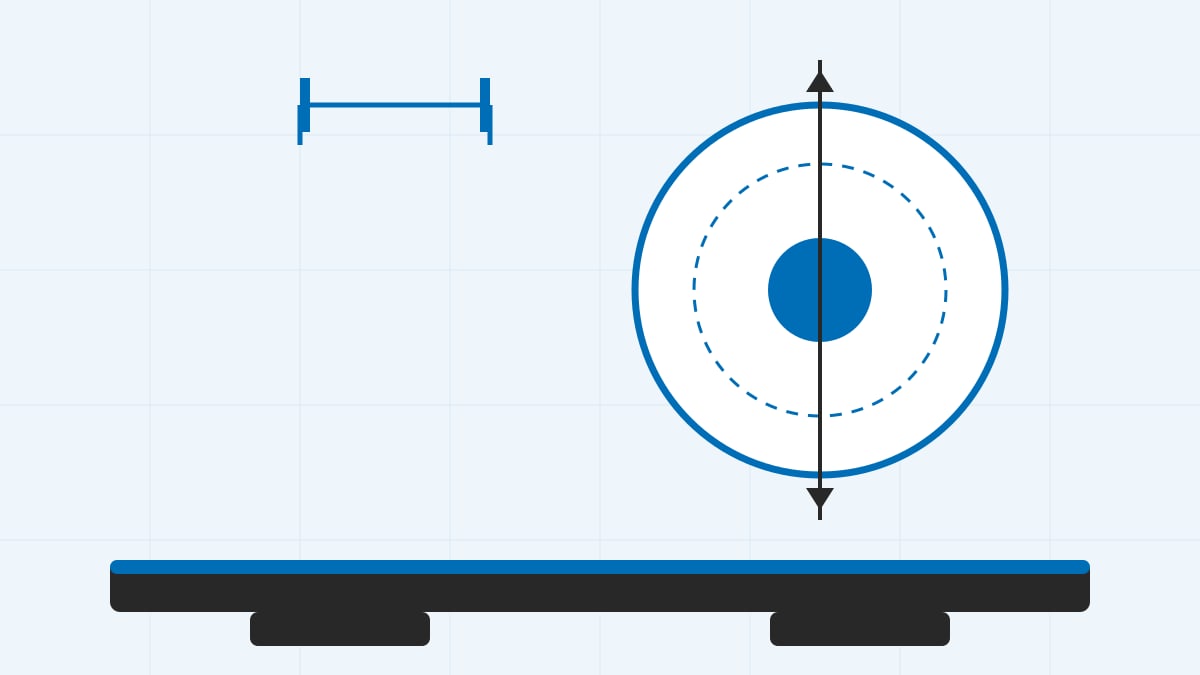
Swing is the first number on any lathe specification, and it is the one that decides whether a machine can do your work at all. Get it wrong in either direction and it costs you: too small and the job will not fit, too large and you have paid for capacity that sits idle while the machine takes up floor space you could have used for something else.
This guide explains what the numbers on a lathe specification actually measure, and how to match a machine to the parts you really turn.
What “swing” measures
Two different figures appear on every specification sheet, and confusing them is the most common buying mistake.
Swing over bed is the largest diameter that will rotate clear of the bed ways without touching anything. It is the headline number, and it is the one used in the model name — a C6140 turns 400 mm over the bed.
Swing over cross slide is the largest diameter you can turn with the carriage under the work. This is the number that limits real jobs, because most turning happens with the saddle somewhere along the bed. It is typically 40–60% of the swing over bed.
A machine rated at 400 mm over the bed will usually only turn about 240 mm over the cross slide. If your parts are 300 mm across and 600 mm long, a C6140 is the wrong machine even though the headline number looks like it fits.
Rule of thumb: size the machine on swing over cross slide, not swing over bed.
The sizes we build
| Model | Swing over bed | Swing over cross slide | Spindle bore | Main motor |
|---|---|---|---|---|
| C6132 | 320 mm | 190 mm | 38 mm | 3 kW |
| C6140 | 400 mm | 240 mm | 52 mm | 5.5 kW |
| C6150 | 500 mm | 300 mm | 52 mm | 7.5 kW |
| C6163 | 630 mm | 350 mm | 82 mm | 11 kW |
| C6180 | 800 mm | — | — | — |
Matching the machine to the work
C6132 — Ø320 mm. Repair shops, toolrooms and training. Bushes, small shafts, pins and general maintenance turning. The small spindle bore means bar work is limited to 38 mm, but for one-off parts this is the most economical way into a lathe.
C6140 — Ø400 mm. The general-purpose choice, and the machine most job shops should start with. A 52 mm spindle bore accepts common bar stock, and 1,000–1,500 mm between centres covers the majority of shaft work that comes through a general workshop.
C6150 — Ø500 mm. For shops that regularly handle medium shafts, flanges and rolls. The extra 100 mm of swing over the cross slide is the difference between a machine that just manages a job and one that does it comfortably.
C6163 — Ø630 mm. Heavy turning. A 82 mm spindle bore and 11 kW motor let you take real cuts in large diameter work, and up to 3,000 mm between centres handles long shafts without a steady-rest workaround.
C6180 — Ø800 mm. Large rolls, heavy fabrication and the biggest work a general machine shop sees. If you are looking at this size you already know why you need it.
The spindle bore catches people out
Swing gets all the attention, but spindle bore decides whether you can feed bar stock through the headstock — and that changes how you work.
A 38 mm bore on the C6132 means bar work stops at roughly 35 mm. Step up to the C6140 or C6150 and you get 52 mm, which covers a very large share of common stock sizes. The C6163 opens up to 82 mm.
If a meaningful part of your work starts as bar, choose on bore first and swing second.
Between centres: buy length, not just diameter
Distance between centres is quoted as a pair — 750/1,000 mm, 1,000/1,500 mm, 1,500/3,000 mm — because the same bed is offered in different lengths.
Long shafts need support. If a part is more than roughly ten times its diameter, it will deflect under cutting force unless it is supported by a travelling steady or a tailstock centre. Buying a longer bed without the steady rests to go with it does not solve the problem.
A short checklist before you order
- Measure your largest current part, not your largest ever job.
- Add roughly 20% headroom for the work you expect to win.
- Check the diameter you need with the carriage under the work.
- Check the spindle bore against the bar you actually buy.
- Check the length against your longest shaft, and budget for steady rests.
- Confirm the electrical supply can carry the motor — 11 kW needs a proper supply.
Confirm the specification with us
The figures in this article are typical values for this class of machine and change with the configuration you order — spindle bore, centre distance and motor rating all vary between builds.
If you send us a drawing or describe the parts you turn, we will recommend a size and send a specification sheet with the exact configuration quoted. Talk to our team and we will come back with a machine recommendation and a price.