
CNC Lathe Machine for India
Flat-bed and slant-bed CNC lathe machines built to order in 400–1250 mm swing, fitted with GSK, KND, Syntec, FANUC or Siemens control. Eight models, one of them set up for milling in the same clamping. Every set ships as a complete CNC machine tools package, with control, chuck, turret and documentation matched to the order. A cnc turning machine in this range is quoted with the control, the tooling package and the sea freight listed separately, so two offers can be read line by line.
A conventional lathe turns one part at a time. A CNC lathe turns the same part the same way, all day.
The difference is not that CNC is "better" — it is that the machine holds the dimension for you instead of asking the operator to keep watching a dial. If your work repeats, or if you need to hold tolerance on a batch without a skilled hand at the wheel, CNC is the practical choice.
Repeatability, not just accuracy
A careful operator can hit 0.02 mm on a good day. A CNC lathe holds it on part one and part five hundred, because the tool path is stored in the control, not in the operator's hands.
Shorter cycle on batch work
Roughing, finishing, threading and grooving run in one program without stopping to change a feed lever. On a 200-piece run the time saved is measured in shifts, not minutes.
One operator, several machines
Once the program is proven, one person can look after two or three machines. That is usually the figure that decides the payback, more than the faster cutting speed.
Difficult profiles made routine
Radii, chamfers, tapers and multi-start threads that need a form tool on a manual lathe become ordinary moves in the program. Profiles you would normally refuse are suddenly worth quoting.
Scrap stops being a hidden cost
Most scrapped parts on a manual lathe come from a missed handwheel graduation or a tool change done too late. A CNC lathe does not get tired at 4 p.m.
Programs are your property
The job stays in the machine. When you train a new operator you hand over a program and a proven process, not a skill that walks out of the door with the person who had it.
You run batches of the same part, you need a documented tolerance, or you cannot find a skilled turner to run a manual machine reliably.
Your work is one-offs, repair jobs and fixtures where setting up a program costs more time than cutting the part by hand. Most workshops end up with both.
Choose your CNC lathe machine platform
Three ways to build a lathe: a horizontal bed for shafts, a slant bed for production, and a turn-mill when the part needs milling as well as turning. Pick the one that matches the work you do most. Whichever you choose, a CNC cutting machine only earns its keep when the cycle fits your batch size, so we quote the cycle on the CNC lathe before you commit. If you would rather hand the part out than buy the machine, our CNC machining services team can quote the run as well.
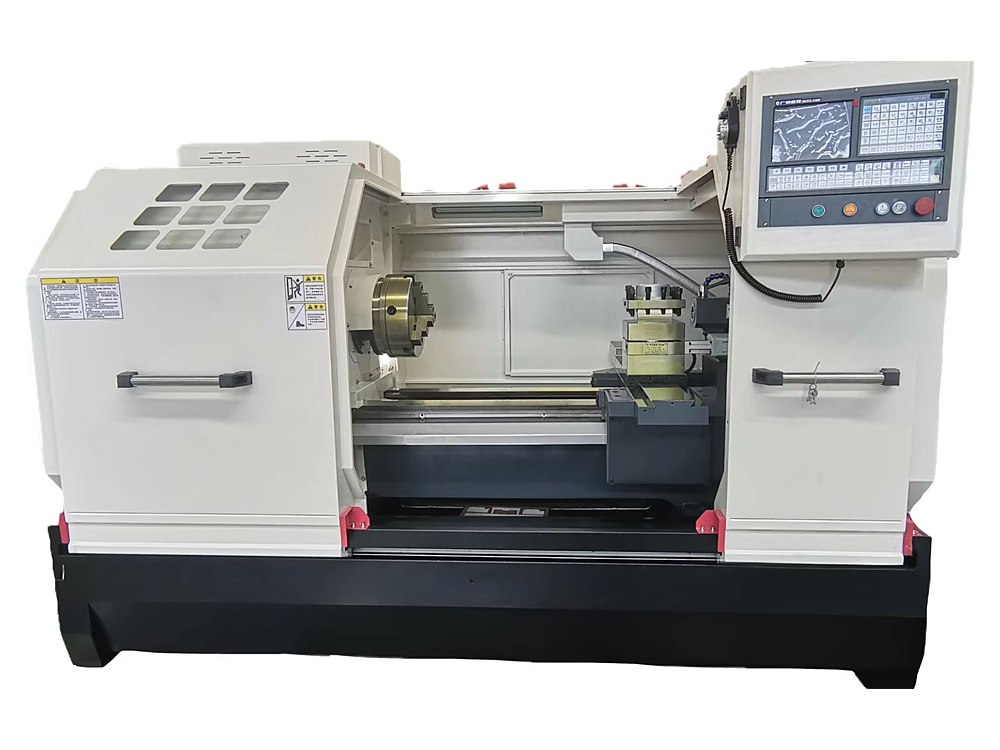
CKNC-6180 · 800 mm swing · 600 mm bed
Flat-bed Lathe
Long travel along a horizontal bed. The right choice for shaft work, repair jobs and shops that want a setup anyone can understand.
Six models · Φ400–1250 mm swing
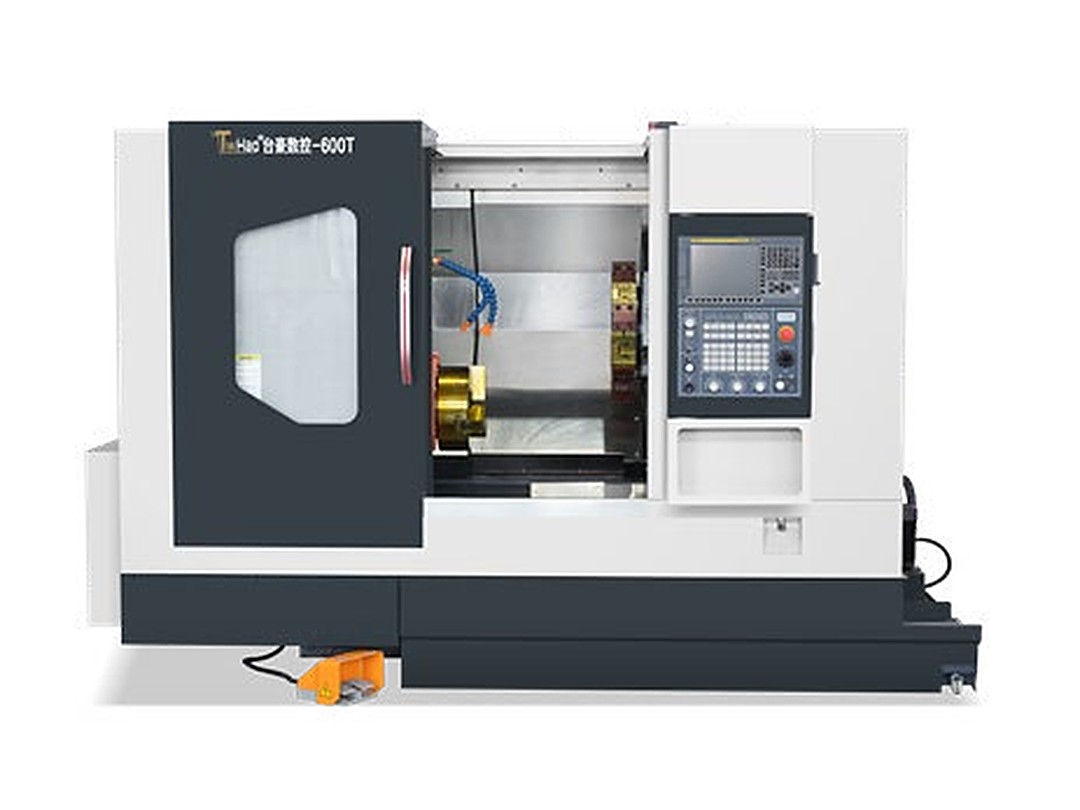
CK-600T · 650 mm swing · 12-station turret
Slant-bed Lathe
A 45 degree bed sheds chips by gravity and lets the tool reach the part faster, which shortens cycle time on repeated work. That is why a slant bed is the default for bar work, and why its cnc lathe machine price sits above a flat bed of the same swing.
Five models · 30–45° bed · turret & tailstock
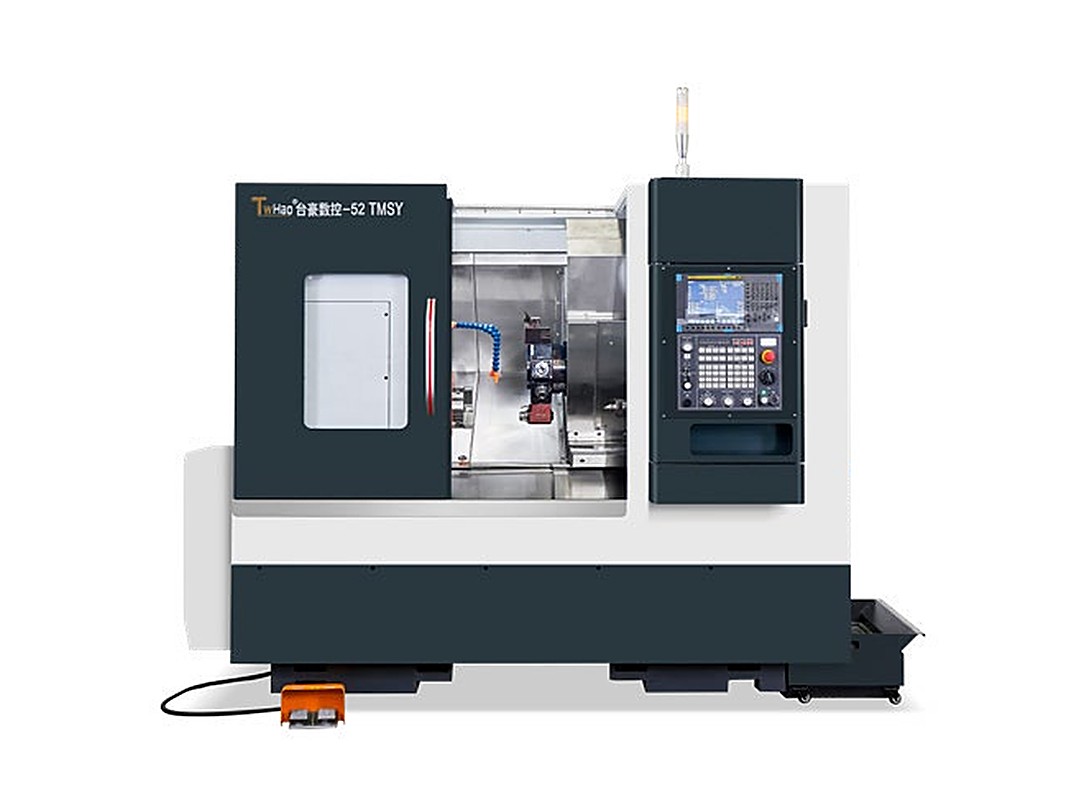
CK-52TMSY · 650 mm swing · BMT45 driven · Y ±50 mm
Turn-mill CNC Lathe
A driven turret plus a Y axis, so cross-holes, flats and slots are finished in the same clamping as the turning. One setup, one tolerance stack.
Three models · CK46Y / 52TMSY / 600TMSY
Eight machines, two bed designs
Flat-bed models cover shafts, general turning and large flanges up to 1250 mm swing. Slant-bed models cover repeated parts, driven-tool work and production cells. All of them are built to order and can be fitted with GSK, KND, Syntec, FANUC or Siemens control.
Flat-bed CNC lathes
Horizontal bed · 400–1250 mm swing · bed lengths to 4 m Jump to the specification table
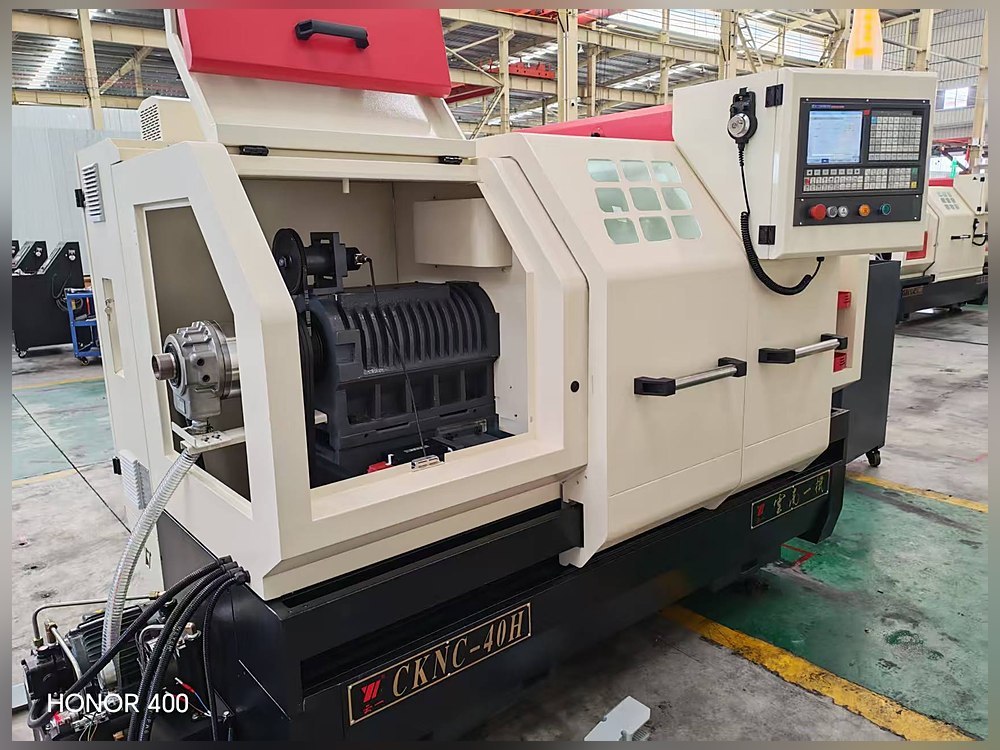
CKNC-40H
Independent-headstock design with a 66 mm through bore and 3000 rpm top speed. The machine we sell most for small shafts, pins and fittings where cycle time matters.
- Swing over bedΦ400 mm
- Between centres750 mm
- Spindle boreΦ66 mm
- Spindle speed3000 rpm
- Weight1700 kg

CKNC-50H
The middle of the flat-bed range and the usual starting point for a general machine shop: 82 mm bore, 4-position toolpost, and bed lengths from 750 mm to 3 m.
- Swing over bedΦ500 mm
- Swing over carriageΦ275 mm
- Spindle boreΦ82 mm
- Spindle speed2500 rpm
- Bed ways401 mm wide
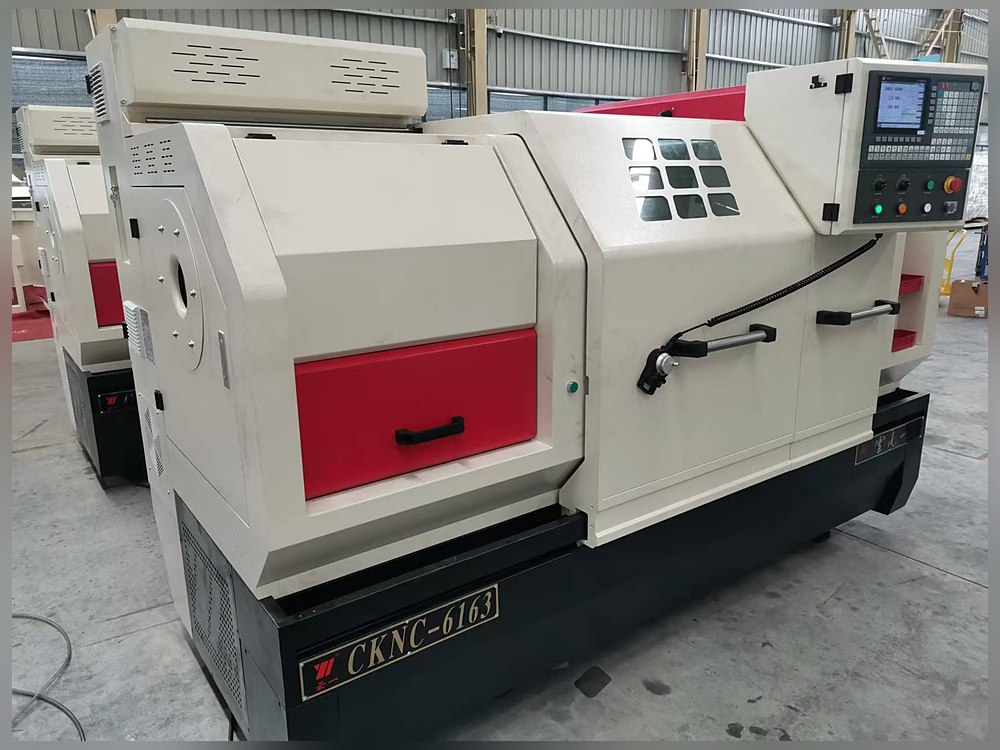
CKNC-6166
Built for longer shafts: three-range variable speed down to 40 rpm for large-diameter work, with bed lengths up to 3 m. Pairs well with a hydraulic tailstock.
- Swing over bedΦ660 mm
- Swing over carriageΦ405 mm
- Spindle boreΦ82 mm / A2-8
- Spindle speed1600 rpm
- Weight~2.9 t (1 m)
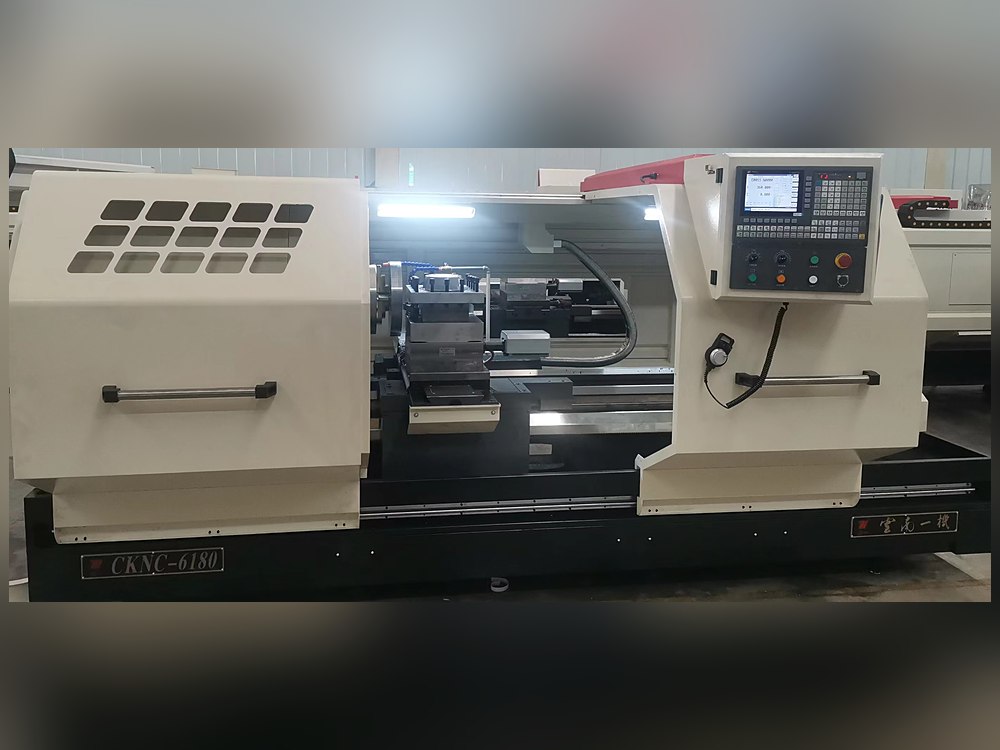
CKNC-6180
A step up in rigidity with a 600 mm bed and a 105 mm bore. Fitted with a 325 mm chuck and 40 mm square tooling as standard.
- Swing over bedΦ800 mm
- Swing over carriageΦ480 mm
- Spindle boreΦ105 mm
- Spindle speed950 rpm
- Bed600 mm wide
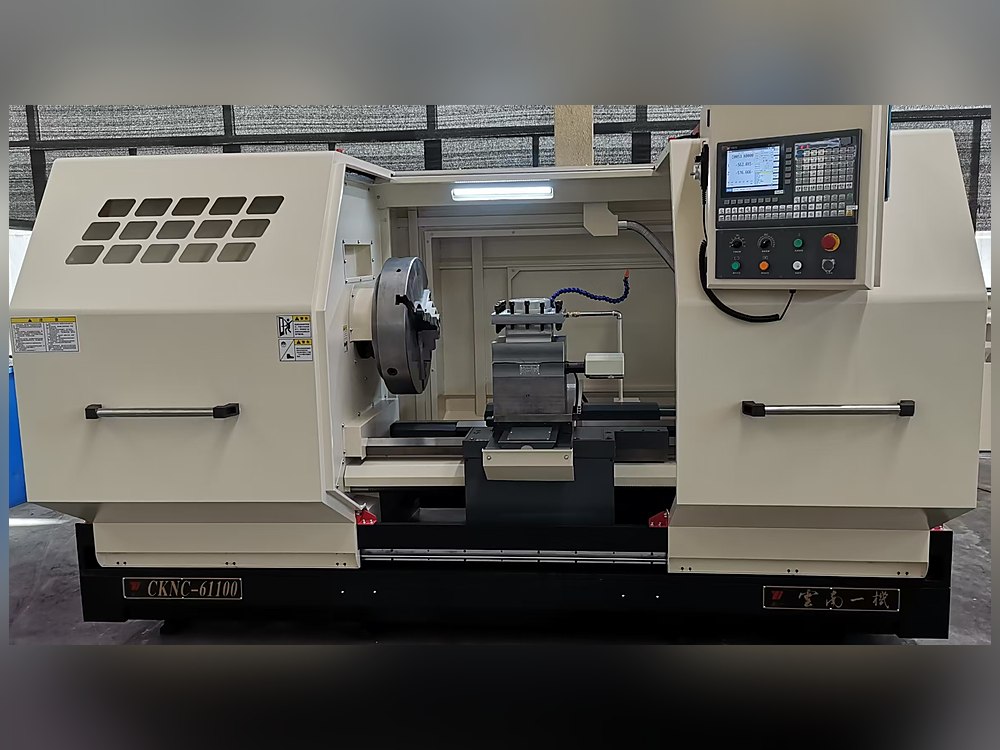
CKNC-61100
Floor-type bed with an 800 mm four-jaw chuck. The machine for flanges, rings and valve bodies that will not fit through a smaller spindle.
- Swing over bedΦ1000 mm
- Swing over carriageΦ680 mm
- Spindle boreΦ105 mm (130 opt.)
- Spindle speed950 rpm
- Chuck800 mm 4-jaw
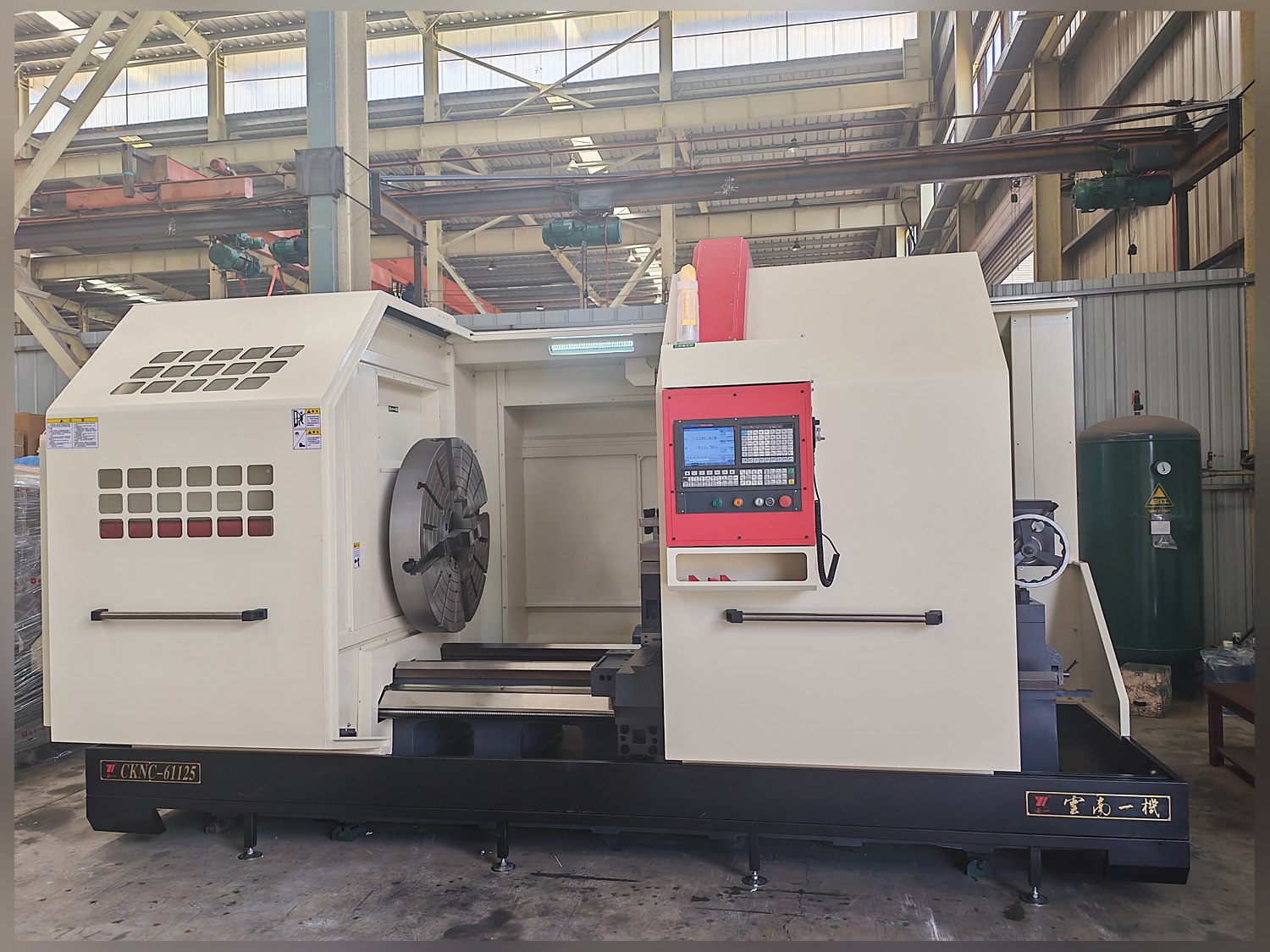
CKNC-61125
The largest flat-bed we build: 755 mm guideway, 130 mm bore, 1000 mm four-jaw chuck. Supplied with an electric tailstock as standard.
- Swing over bedΦ1250 mm
- Swing over carriageΦ880 mm
- Spindle boreΦ130 mm
- Spindle speed370 rpm
- Bed755 mm wide
Slant-bed CNC lathes
30–45° bed · turret, tailstock and driven-tool versions Jump to the specification table
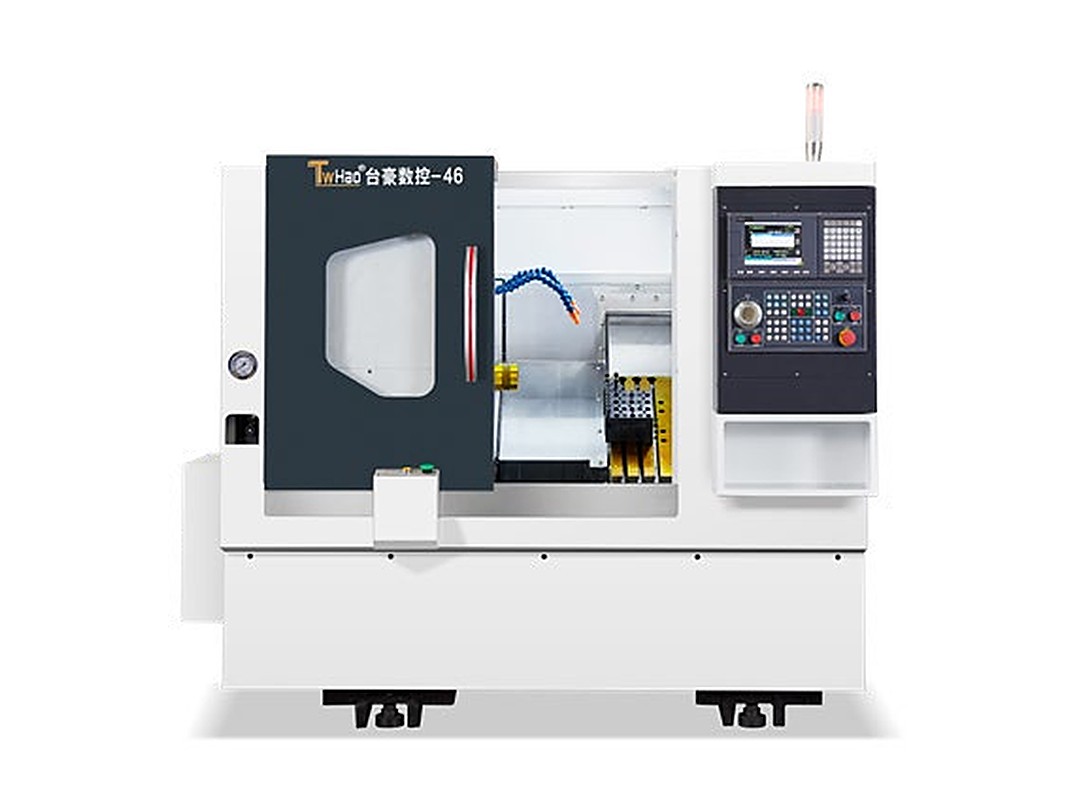
CK46
30° bed with linear guideways and a 5000 rpm cartridge spindle. Fast rapids at 26 m/min make it the pick for small parts run in large numbers.
- Swing over bedΦ360 mm
- Bed angle30°
- Spindle speed5000 rpm
- X/Z travel820 / 300 mm
- Weight2200 kg
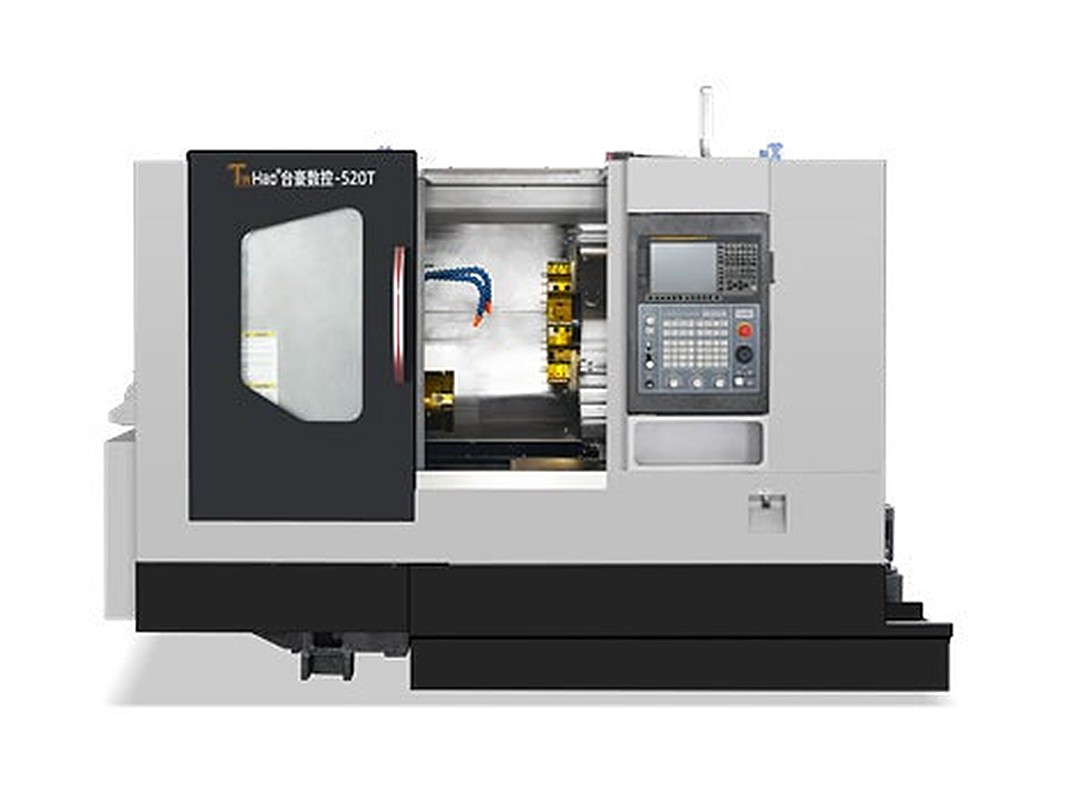
CK-520T
The turret-and-tailstock layout that suits shaft work needing both a driven turret and centre support. A useful bridge between a flat-bed and a full production slant-bed.
- Swing over bedΦ520 mm
- Max. turning dia.Φ360 mm
- Spindle boreΦ66 mm
- Turret8-station
- ControlGSK / Syntec

CK-600T
A2-8 spindle with a 12-station turret and 0.25 s tool-to-tool indexing. 25 m/min rapids and ±0.003 mm positioning make it a genuine production machine.
- Swing over bedΦ650 mm
- Max. turning dia.Φ600 mm
- Spindle boreΦ86 / 102 mm
- Spindle speed3000 rpm
- Weight3800 kg
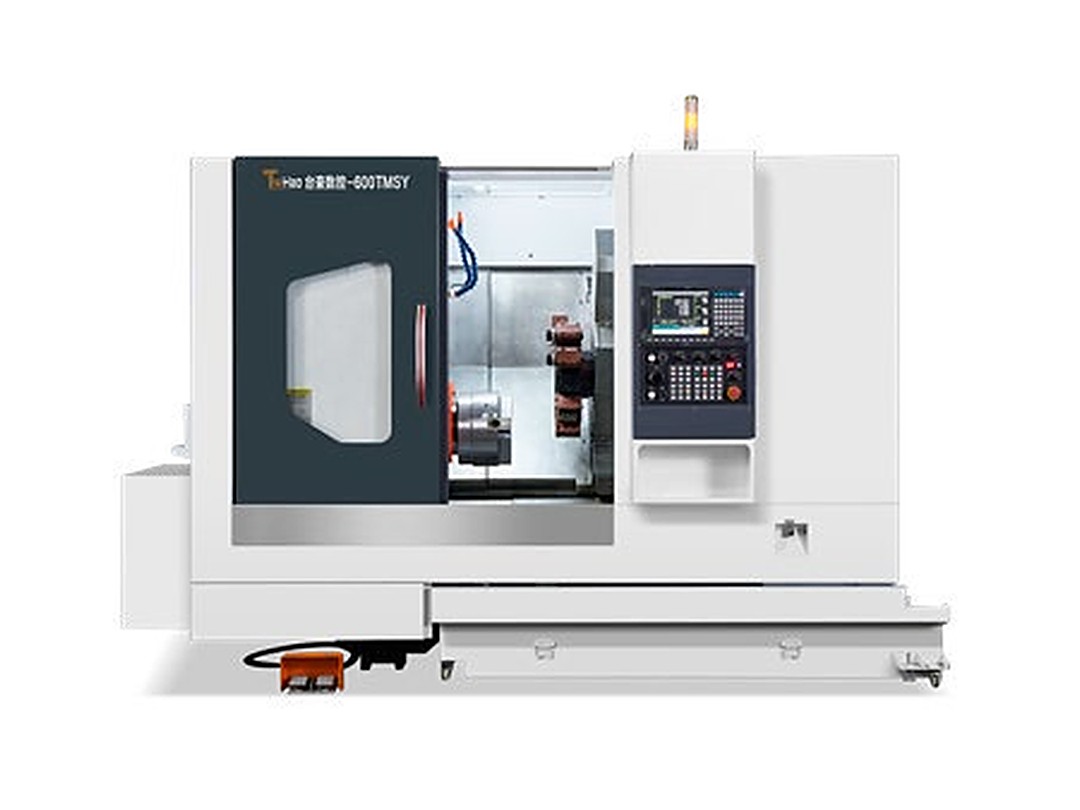
CK-600TMSY
Driven BMT55 turret plus a ±50 mm Y axis, so cross-holes, flats and slots are finished in one clamping. See the turn-mill CNC lathe page for the full walkthrough.
- Swing over bedΦ600 mm
- Y-axis travel±50 mm
- TurretBMT55 driven, 12-station
- Spindle speed3000 / 2000 rpm
- Weight5200 kg
Which control you get, and what the numbers actually mean
The control is the part of a CNC lathe that decides how easy the machine is to live with. We fit GSK as standard because spares and trained operators are easy to find in India; FANUC and Siemens are available if your plant already standardises on them.
| Control | Status | When it makes sense |
|---|---|---|
| GSK 980TDi / TB3i | Standard | Guangzhou CNC. The default on our flat-bed models: well supported in Africa, spares on the shelf, most operators have seen one before. |
| KND 1000T | Optional | Beijing KND. A cheaper alternative with a familiar layout. Good for workshops already running KND on other machines. |
| Syntec 6TA-E / 22TA | Standard on slant-bed | Taiwan Syntec. Fitted as standard on the CK46 / 520T / 600T range, with a graphical interface and conversational programming. |
| FANUC 0i-TF | Optional | The reference control for production turning. Add roughly 8–12% to the machine price and expect a longer lead time. |
| Siemens 828D | Optional | Common on machines going into European-owned plants in India. Prices and lead time on request. |
An honest note on tolerance. The figures above are what the machine is capable of when it is levelled, warm and cutting with a sensible depth of cut. They are not a promise that every part will measure that way on day one. Accuracy comes from the machine, the tooling, the material and the program together — and the first thing to check when a part drifts is almost always the insert, not the lathe. We quote a machining accuracy of IT6–IT7 as a working range, not as a guarantee against a drawing tolerance.
Five questions that decide which lathe you need
Most buyers start from a model number they saw somewhere. It is quicker to start from the part you have to make. Work through these five and the model usually picks itself.
Send us your part drawing →-
01
Start with the part, not the machine
Measure the largest diameter and the longest length you actually cut. Swing over the bed is not the same as swing over the carriage — a 500 mm machine only turns about 275 mm with the toolpost fitted.
-
02
Then the volume
Under about 20 pieces a month, a flat-bed with a manual tailstock is usually the cheaper machine to own. Above that, the faster cycle and the driven turret of a slant-bed start to pay for themselves.
-
03
Then the spindle bore
If bar stock goes through the spindle, the bore decides the machine. 45 mm, 66 mm, 82 mm, 105 mm and 130 mm are the common steps; our models cover all of them.
-
04
Then the length
Bed length is quoted between centres. Allow 200–300 mm beyond the longest part for the chuck and the tailstock, or you will run out of travel on the first long shaft.
-
05
Then the options that actually matter
Hydraulic chuck and tailstock, chip conveyor, and a tool-setter. Skip the rest until the machine has paid for itself — most of the cost of an over-specced lathe is never used.
Flat-bed vs slant-bed CNC lathe machine
| Consideration | Flat-bed lathe | Slant-bed lathe |
|---|---|---|
| Best for | Long shafts, repair work, general turning | Repeated parts, faster cycles, chip control |
| Chip removal | Operator clears swarf from the bed | Chips fall away by gravity |
| Tool reach | Longer travel to the workpiece | Tool sits closer to the cut |
| Typical use | Job shop, maintenance department | Production turning, machine builders |
| Supply options | Complete machine | Complete machine or frame only |
Still unsure? The flat-bed table and the slant-bed table below list every model we build. If your work is closer to a manual lathe than a production cell, conventional lathes are here, and milling-in-one-clamping is covered here.
Standard specification by model
The tables below are the manufacturer's own figures for each model we stock. Where a model is offered in several bed lengths, the length is given as a range — the swing and spindle figures stay the same.
Flat-bed CNC lathes
| Model | Swing over bed | Swing over carriage | Spindle bore | Spindle speed | Bed length | Weight |
|---|---|---|---|---|---|---|
| CKNC-40H | Φ400 | Φ210 | Φ66 | 3000 rpm (stepless) | 750 | 1700 kg |
| CKNC-50H | Φ500 | Φ275 | Φ82 | 2500 rpm | 750–3000 | — |
| CKNC-6166 | Φ660 | Φ405 | Φ82 A2-8 | 1600 rpm (3 range) | 750–3000 | ~2900 kg (1 m) |
| CKNC-6180 | Φ800 | Φ480 | Φ105 | 950 rpm (3 range) | 750–4000 | — |
| CKNC-61100 | Φ1000 | Φ680 | Φ105 (130 opt.) | 950 rpm (3 range) | 750–4000 | — |
| CKNC-61125 | Φ1250 | Φ880 | Φ130 | 370 rpm (3 range) | 1500–3000 | — |
- All dimensions in millimetres unless otherwise stated. — = not a fixed figure for this model.
- Swing over carriage is the figure that limits most real work — check it against the largest diameter you turn with the toolpost in position.
- Weights are for the shortest bed length and exclude the chuck and steady.
Slant-bed CNC lathes
| Model | Swing over bed | Max. turning dia. | Spindle bore | Spindle speed | Turret | Weight |
|---|---|---|---|---|---|---|
| CK46 | Φ360 | Φ300 (disc) | Φ55 | 5000 rpm | 8-tool gang | 2200 kg |
| CK-520T | Φ520 | Φ360 | Φ66 | 4500 rpm | 8-station | ~3300 kg |
| CK-600T | Φ650 | Φ600 | Φ86 / Φ102 | 3000 rpm | 12-station | 3800 kg |
| CK-600TMSY | Φ600 | Φ550 | Φ52 / 75 / 89 | 3000 / 2000 rpm | BMT55 driven, 12-station | 5200 kg |
- CK46 is a gang-tool layout; 520T and 600T are turret machines; 600TMSY adds a driven BMT55 turret and a ±50 mm Y axis.
- Spindle speeds are the maximum for the standard configuration. A different chuck or cylinder can reduce the usable top speed.
- Specifications are the manufacturer's typical values and may change without notice. The binding figures are the ones on your order confirmation.
Not sure which of these fits your part?
Send the drawing, the material and how many you make a month. We will come back with one model, the options worth paying for and the options to skip — not a list of eight.
CNC lathe machine questions before you order
Straight answers to what buyers ask before they place an order.
Is a CNC lathe the same as a cnc turning machine?
In practice, yes. The lathe is the machine and turning is the operation it performs, so buyers searching a cnc turning machine are looking at the same flat bed and slant bed lathes described on this page.
How do I compare a cnc machine price in india between suppliers?
Ask for four lines: machine price, control model, tooling list and freight. A single delivered figure hides which of the four moved, and that is where offers stop being comparable.
Which control should I order?
GSK and KND keep the purchase price down and service is available in India. FANUC and Siemens cost more and suit shops that already standardise on them. All four are fitted in the same cabinet.
What is the lead time on a cnc lathe machine?
A stock build leaves in two to three weeks. A machine built to your swing, bed length and turret takes six to eight weeks at the works, before the sea leg.
CNC lathe machine price and lead time
Tell us the platform, the swing and the bed length you need. We will confirm the right spindle bore, the control you will be happiest with, and a landed price in India — not an FOB number you have to add freight and duty to yourself.
If you need it now rather than in eight weeks, our showroom units are demonstration machines at reduced price. For work that is mostly milling, see the turn-mill lathes; for anything that is not a lathe at all, the other equipment page covers grinders, drills, mills and EDM.
